
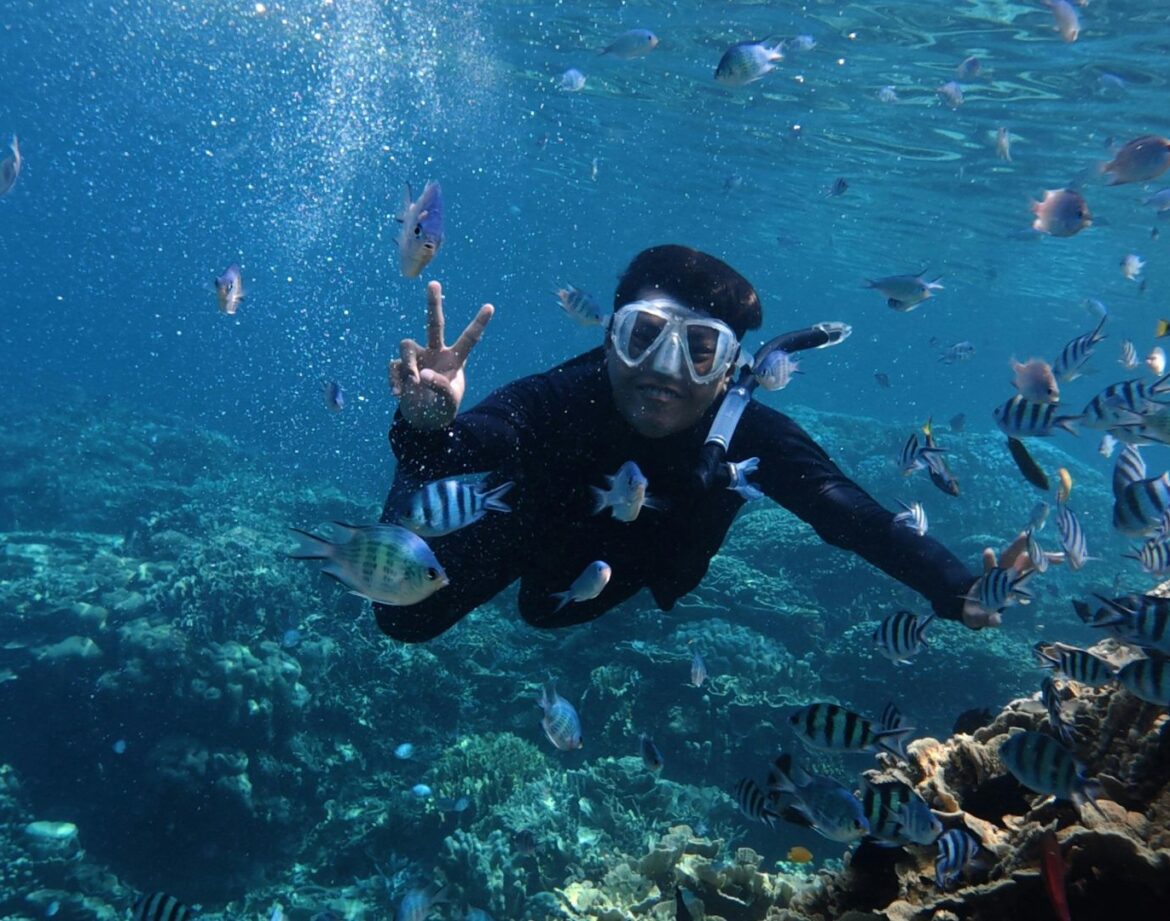
Scuba Diving Around Mykonos
Beneath the surface that everyone photographs — the postcard blue, the reflections of whitewashed walls, the hulls of superyachts swinging at anchor — Mykonos holds an entirely different world. One that has nothing to do with fashion or nightlife or the particular social theatre that plays out on the island’s beaches every summer. The underwater world around Mykonos is quiet, indifferent to all of that, and in its indifference, genuinely restorative.
The island sits at the intersection of several deep Aegean channels, and the result is underwater topography that surprises people who assume the seafloor of a tourist island must be picked over and unremarkable. Walls drop sharply from the surface into darkness. Overhangs shelter colonies of sponge and fan coral in colours that only become visible when a torch beam hits them. Open sandy plains give way to rock formations that rise like submerged architecture, encrusted with decades of marine growth. Visibility regularly exceeds twenty metres in the summer months, and the water temperature, which sits around 22 to 24 degrees Celsius through the peak season, means a three-millimetre wetsuit is comfortable for most people on dives down to fifteen or eighteen metres. The conditions, in short, are about as good as recreational diving gets in European waters.
The most celebrated site is the Armenistis wreck, and it earns its reputation. A cargo ship that went down in the early 20th century, it now rests at around 25 metres on a sandy bottom a short boat ride from the port, its hull listing slightly to one side, the superstructure collapsed but still recognisable, the whole structure colonised over a century of submersion into something that no longer feels like a shipwreck so much as a reef that happens to be made of steel. Grouper hold position in the shadows of the hold. Moray eels extend from crevices in the corroded metalwork. Octopus have settled into every available corner, watching your approach with the particular calm intelligence that makes them the most unnerving thing you are likely to encounter underwater. On a good day, with the visibility up and the current minimal, you can circle the entire wreck on a single tank and spend the surface interval trying to describe what you saw to the people on the boat who didn’t dive.
The wreck is accessible to intermediate divers — PADI Open Water certification or equivalent is sufficient, though a wreck specialty course will make the experience considerably richer. For beginners and those who have never dived at all, the sheltered rocky coves around Agios Stefanos on the island’s north coast provide gentle entry dives in five to ten metres of water, with good fish life, ample light, and the kind of forgiving conditions in which people regularly discover that breathing underwater is, after the first thirty seconds of managed panic, one of the most natural feelings in the world. Sea turtles pass through this area with enough regularity that sightings are not unusual, though they are never guaranteed — which is part of what makes them memorable when they happen.
Several dive centres in Mykonos Town are PADI-certified and have been operating long enough to have their logistics well sorted. The standard discover dive — an introductory experience for non-certified divers that involves a short briefing, a confined water session in shallow conditions, and then an open water dive to around five metres accompanied by an instructor — runs around €60 and takes up most of a morning. Full open water certification courses run across three days and include classroom sessions, confined water training, and four open water dives. By the end you are a certified diver, able to dive anywhere in the world to eighteen metres, and you have done your qualifying dives in the Aegean, which is not a bad way to start.
Night dives are available through most operators with advance booking, and they are worth the advance booking. The reef and rock formations around Mykonos after dark are occupied by an entirely different cast of creatures — octopus out hunting in the open, sleeping parrotfish wedged into crevices, the occasional squid tracking your torch beam with apparent curiosity. On calm nights in late summer, the bioluminescent plankton that occasionally blooms in these waters produces a phenomenon that is genuinely difficult to describe to someone who hasn’t seen it: every movement of your hand through the water trails a brief constellation of cold blue light, and the bubbles rising from your regulator trace a luminous column toward the surface. It is the kind of thing that stays with you long after the tan has faded and the beach club receipts have been filed away and forgotten.

